Five Babies, One Accusation, and a Mother Left to Face Everything Alone
The maternity ward should have been overflowing with joy that morning in 1995.
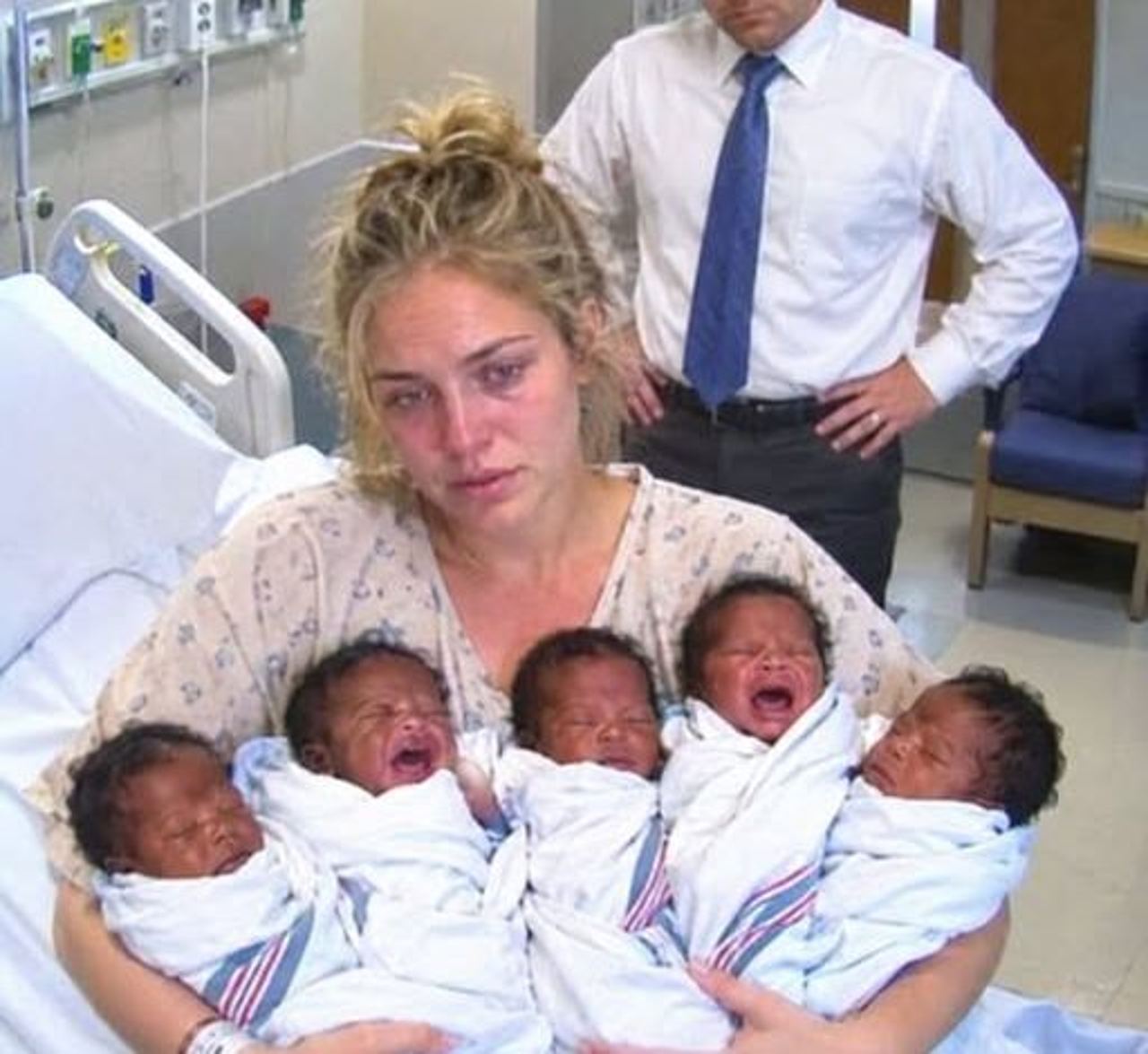
After months of a difficult pregnancy, endless doctor visits, sleepless nights, and nervous preparation, a young woman had finally brought five babies into the world.
Five tiny human beings.
Five hearts beating.
Five children born at the same time, each one delicate, beautiful, and completely reliant on the people who had given them life.
Their cries filled the hospital room, blending together in a chorus that seemed astonishingly loud for such tiny bodies. Nurses moved briskly from crib to crib, adjusting blankets, checking on the newborns, and offering reassurance to their exhausted mother.
She rested against her pillows, overwhelmed by the enormity of what had just taken place.
During the pregnancy, there had been moments when she doubted whether she would have the strength to endure it. Carrying quintuplets had placed enormous strain on her body, and the uncertainty of the delivery had frightened her more than she wanted to admit.
But now they had arrived.
She could see their tiny hands, their delicate features, and the soft rise and fall of their breathing.
Every fearful moment suddenly felt worth it.
With tears sliding down her face, she turned toward the man standing beside her hospital bed.
She expected a smile.
She expected him to take her hand, kiss her forehead, and stand in wonder at the five children they had brought into the world together.
Instead, his face changed.
His eyes moved from one baby to the next. His brow tightened, and the warmth she had hoped for disappeared.
He was staring at their dark skin.
For several long seconds, he remained silent.
Then he whispered words that would alter the course of six lives.
“They’re Black.”
The young mother looked at him, confused by the suspicion and fear in his voice.
“Yes,” she replied softly. “And they’re beautiful.”
But he kept staring.
His confusion hardened into anger.
“How is this possible?” he demanded. “Look at them. Look at us.”
She struggled to grasp what he was implying.
“They’re our children,” she told him. “All five of them.”
He took a step back.
“No. That can’t be true.”
Her exhaustion vanished beneath a surge of panic.
“What are you saying?”
He looked at the babies once more, then back at her.
“You betrayed me.”
The accusation hit harder than anything she had endured during pregnancy.
She tried to explain, but he refused to listen.
There was no evidence of infidelity. No confession. No discussion about the complexities of inherited traits.
There was only his instant conclusion that the babies’ appearance meant their mother had been unfaithful.
And in his mind, that conclusion became unquestionable truth.
She reached toward him.
“Please. Don’t do this. They’re your children.”
But he turned away.
Without holding even one baby, without comforting the woman beside him, and without considering what his leaving would mean for five newborns, he walked toward the door.
She called after him.
He never came back.
The door shut.
And the woman who had entered that hospital expecting to begin a new life with her partner suddenly found herself standing at the start of motherhood alone.
There would be no shared joy, no father helping with late-night feedings, and no second pair of hands when all five babies cried at once.
The children had not changed.
They were still the same precious babies who had arrived only hours earlier.
What had changed was one man’s willingness to love them.
That evening, as the hospital grew quieter, their mother looked at the five little faces resting around her.
She did not know how she would manage.
She did not know where the money would come from, who would help her, or how she would survive the sleepless months ahead.
But she knew one thing.
She would never leave them.
Leaning toward the nearest crib, she whispered a promise.
“It doesn’t matter who walks away from us. You are my children, and I will always be here.”
It was a promise she would spend the next thirty years honoring.
A Home Built Through Sacrifice
The first months were more difficult than anything she had imagined.
Caring for one newborn is demanding under normal circumstances. Caring for five at the same time requires extraordinary patience, time, organization, and support.
But she had almost none of the support she needed.
There were bottles to make, diapers to change, laundry to wash, and medical appointments to keep.
When one baby finally fell asleep, another woke up.
When two stopped crying, the others often started.
There were nights when she could barely remember the last time she had slept for more than an hour.
She learned to recognize each child’s cry.
One cried from hunger. Another became restless when uncomfortable. One needed to be held a little longer before settling.
Their smallest movements became familiar to her.
She came to understand that motherhood was not only about feeding and dressing children. It was about paying close attention when exhaustion made attention almost impossible.
It was about listening.
It was about remaining present even when she felt she had nothing left to give.
Money quickly became another source of fear.
The expenses were crushing. Five babies needed food, clothes, supplies, and healthcare, and the family’s small savings could not last forever.
The man who had abandoned them offered no meaningful support.
So the young mother began searching for work she could do around the needs of her children.
She cleaned offices after business hours.
She mended and sewed clothes whenever someone needed an inexpensive alteration.
She took difficult jobs that many other people did not want.
Sometimes she returned home with aching hands and swollen feet, knowing the next morning would begin before sunrise.
She learned how to stretch every dollar.
Clothing was repaired instead of replaced. Meals were planned carefully. Household costs were calculated over and over again.
She developed a remarkable ability to turn almost nothing into just enough.
There were times when she quietly denied herself something she wanted so her children could have something they needed.
When the refrigerator was nearly empty, she assured them she would find a way.
When winter came, she checked their blankets before thinking about her own comfort.
When one child got sick, she stayed awake all night giving comfort while silently calculating whether she could afford to miss work the next day.
She was not a perfect mother.
There were moments when frustration overtook her.
There were evenings when she wept in private.
At times, the sheer weight of responsibility frightened her.
But she never allowed those hard moments to persuade her that her children were a burden.
To her, they were five reasons to continue.
And even when she had almost nothing material left to offer, she gave them the one thing she could provide without limit.
Love.
The Cruelty Waiting Outside Their Door
Sadly, poverty was not the only hardship this family faced.
The children also grew up surrounded by prejudice.
The contrast between their mother’s lighter complexion and their darker skin drew attention that never should have been directed at them.
Strangers stared too long.
Neighbors asked invasive questions.
People who knew almost nothing about the family felt entitled to speculate about where the children had come from.
Some suggested their mother had been hiding a secret.
Others repeated the same accusation their father had made on the day they were born.
The rumors spread easily because gossip required no proof.
People saw a family that did not fit their expectations, and instead of questioning those expectations, they questioned the mother’s character.
She learned that prejudice does not always arrive as an obvious insult.
Sometimes it appeared in an uncomfortable silence when she introduced her children.
Sometimes it was a landlord suddenly claiming that a vacant apartment had already been taken.
Sometimes it was another parent ending a conversation the moment they noticed her family.
And sometimes it came from people who smiled politely before asking questions designed to humiliate her.
“Are they really all yours?”
“Where is their father?”
“Do they all have the same father?”
At first, she tried to explain.
Then she realized that some people were not interested in understanding.
They were interested in finding something to condemn.
Even so, the children’s mother refused to let bitterness become the foundation of her home.
She understood that the world could be harsh, but she did not want her children growing up believing that cruelty was unavoidable or that their worth depended on the approval of strangers.
When they experienced unfair treatment, she listened.
When they came home confused by someone else’s comments, she answered their questions as honestly as she could.
And when they wondered why some people seemed determined to judge them, she reminded them that ignorance was not a measure of their value.
“Never let someone else’s opinion become the voice inside your head,” she would tell them.
She taught them to respect themselves and other people.
She encouraged them to confront unfairness without losing their compassion.
Above all, she wanted them to understand that their skin color was never something to apologize for.
They were beautiful exactly as they were.
The problem had never been the way they looked.
The problem was the prejudice of those looking at them.
Five Children, Five Distinct Dreams
As the years went by, the quintuplets grew into five very different people.
Though they shared the same birthday and were raised under the same roof, their personalities, interests, and ambitions were strikingly different.
Their mother realized early that raising five children did not mean raising five identical versions of the same person.
Each one needed support in a different form.
One child was fascinated by buildings.
While the others played, this child spent hours stacking blocks, studying shapes, and drawing imaginary houses.
Old cardboard boxes became elaborate structures. Scraps of paper turned into floor plans.
Their mother noticed that interest and encouraged it.
When there was no money for expensive building toys, she saved cartons and other materials that could be used for creative projects.
Years later, that childhood fascination grew into a career in architecture.
The child who once designed pretend houses became an adult capable of creating real spaces where families could live, work, and gather.
Another child possessed an unusually strong sense of justice.
Even when young, this sibling questioned rules that seemed unfair and spoke up when someone was treated badly.
Discussions at the dinner table sometimes became passionate debates about what was right and what was unjust.
Instead of silencing that determination, their mother taught the child to support opinions with facts and disagree respectfully.
That same determination eventually led to a career in law.
The child became a lawyer, drawn by the opportunity to help people who struggled to have their voices heard.
For the mother, there was something especially meaningful in watching one of her children defend fairness in a world that had so often denied it to their own family.
The third child found comfort in music.
There had always been singing in the family’s small home.
Sometimes their mother hummed while cooking dinner or folding laundry.
Sometimes all five children sang together, turning ordinary evenings into joyful performances.
But one voice stood apart.
As the years passed, that child’s passion became unmistakable.
Music was more than entertainment. It was a way of expressing feelings that were difficult to put into words.
With encouragement, practice, and determination, that passion developed into a career as a singer.
Another sibling showed a natural gift for solving problems.
This child was organized, observant, and deeply interested in understanding how things worked.
Even in childhood, there was a habit of asking practical questions and offering solutions.
As an adult, those abilities became valuable in business consulting, helping organizations make decisions and improve the way they operated.
The fifth child saw the world through art.
Colors, textures, and everyday scenes offered endless inspiration.
While others rushed past ordinary objects, this child noticed patterns, shadows, and details that seemed invisible to everyone else.
Their mother saved pencils, encouraged sketches, and celebrated every creative effort.
Eventually, that curiosity grew into a professional artistic career.
Five children.
Five roads.
Five futures that once had seemed almost unimaginable.
None of their achievements happened overnight.
There were disappointing grades, failed applications, financial barriers, and moments of deep self-doubt.
Their mother could not remove every obstacle.
She could not always provide the same opportunities that other families could afford.
But she encouraged them, helped them find alternatives, and reminded them that their circumstances did not have to define their destination.
They learned discipline by watching her work.
They learned responsibility by helping one another.
They learned resourcefulness in a household where waste was rarely an option.
And they learned loyalty from the woman who had stood beside them from the beginning.
Their achievements were their own.
Yet behind every success was a childhood shaped by their mother’s extraordinary perseverance.
The Questions That Never Fully Went Away
Even as the quintuplets grew into accomplished adults, one painful subject continued to follow them.
Their father.
When they were young, they asked the questions children naturally ask.
Why didn’t he come to see them?
Did he know where they lived?
Had they done something wrong?
Did he ever think about them?
Their mother tried to answer without planting hatred in their hearts.
She never told them that their father had left because they were unworthy of love.
She wanted them to understand that an adult’s refusal to accept responsibility is never a child’s fault.
As they grew older, they learned more about what had happened in the hospital.
They learned that he had questioned their mother’s faithfulness because of how they looked.
They learned that his accusations had followed the family through years of gossip.
And they began to understand how much emotional pain their mother had carried without allowing it to swallow their childhood.
They believed her.
They had lived with her honesty all their lives.
They had watched her sacrifice when no one was praising her.
They knew the character of the woman who had raised them.
But the outside world kept asking questions.
From time to time, someone revived the old rumors.
A careless comment at a social event could bring back memories of childhood humiliation.
A stranger might question their family ties as though decades of love meant nothing.
For years, the siblings tried to ignore such remarks.
They built careers, formed friendships, and pursued their own lives.
Still, the unanswered biological question lingered in the background.
Then one evening, during a family gathering, the subject resurfaced.
The five siblings were sitting together, talking about their childhood and the extraordinary life their mother had struggled to build.
Someone mentioned yet another moment when their family history had been questioned.
The room fell quiet.
Then one sibling made a suggestion.
“What if we did a DNA test?”
At first, no one responded.
They all understood what such a test could mean.
The results might confirm what their mother had always said.
They might also reveal something none of them expected.
Their mother had never demanded proof of her innocence.
In fact, she had lived for years as if her dignity required no public validation.
But the children wanted clarity.
Not because they doubted her.
Because they were tired of seeing others treat her honesty as though it were a mystery still waiting to be solved.
After discussing it carefully, they agreed.
They would seek genetic testing.
Whatever the outcome, they would face it together.
The Envelope That Changed Everything
The day the results arrived, the siblings gathered once again.
Their mother sat nearby, watching them with a mixture of emotion and curiosity.
Three decades had passed since the day their father abandoned them.
Thirty years of birthdays.
Thirty years of struggle.
Thirty years of ordinary family moments that had slowly built an extraordinary life.
And now, scientific testing could answer a question that had shaped their family’s history.
One sibling opened the report.
The others leaned in.
For a moment, no one said a word.
Then they began to read.
The genetic findings confirmed what their mother had insisted from the beginning.
The man who had stormed out of the hospital in anger was their biological father.
The family relationship had never been a lie.
There had been no secret affair to explain the children’s existence.
Their mother had been telling the truth.
The siblings looked at each other in disbelief.
One started crying.
Another reached for their mother’s hand.
The silence in the room held years of memories: the insults, the whispers, the moments when strangers had treated their mother as if she owed the world an explanation.
All of it came rushing back at once.
Their mother lowered her eyes.
She had never needed a lab report to know the truth.
But hearing her children acknowledge that confirmation moved her deeply.
“Mom,” one of them said, “you were telling the truth all along.”
She looked up.
“I know,” she replied.
There was no triumph in her voice.
Only the quiet sadness of someone who had carried an unnecessary accusation for far too many years.
For the children, the results brought relief.
But they also brought anger.
They realized their father had missed thirty years of their lives because he had let suspicion overpower responsibility.
He had missed their first steps.
Their first days of school.
Their birthdays, graduations, difficult seasons, and accomplishments.
He had missed the opportunity to know five extraordinary people.
And now, whatever he might feel about the results, none of those lost years could be returned.
What Genetics Can Actually Tell Us
The results raised another important question.
How could children have much darker skin than two lighter-skinned parents?
The answer begins with the complexity of human genetics.
Skin color is not controlled by a single gene or by a simple rule requiring children to resemble the average appearance of their parents.
Instead, human pigmentation is influenced by many genetic variants, each contributing in different ways to the amount, type, and distribution of melanin.
Melanin is the natural pigment involved in determining skin, hair, and eye color.
Every child inherits genetic material from both biological parents.
Because the combination of inherited variants differs from child to child, siblings can look noticeably different from one another.
Some children strongly resemble one parent.
Others show features associated with grandparents or more distant ancestors.
And some inherit combinations of traits that neither parent visibly expresses in the same way.
This helps explain why appearance alone is not a reliable method for determining biological parentage.
A child can have a skin tone that is lighter or darker than either parent’s, although the degree of difference and the likelihood of a particular outcome depend on the family’s genetic background.
It is also important to understand that racial identity and skin pigmentation are not interchangeable scientific categories.
Skin color exists across a wide spectrum, and many families have complex ancestral histories that are not obvious from appearance alone.
The oversimplified claim that two parents merely carry a single hidden recessive gene for dark skin is not an adequate explanation for human pigmentation.
Real inheritance involves many genes and their interactions.
In cases where biological relationships are genuinely disputed, properly conducted DNA parentage testing offers far more reliable evidence than visual assumptions.
And in this fictional family’s story, that distinction changes everything.
The father treated appearance as proof.
He mistook suspicion for certainty.
If he had been willing to ask questions, seek medical advice, or consider that his understanding might be incomplete, the history of this family could have been very different.
Instead, he made a life-changing decision based on what he believed he saw.
The scientific lesson extends beyond one family.
Human appearance can be surprising.
Genetic inheritance is complex.
And no person’s honesty, morality, or family relationships should be judged solely by skin color.
When the Community Learned the Truth
As news of the DNA results spread, the people who had judged the family were forced to confront an uncomfortable reality.
The mother they had doubted for decades had been telling the truth.
The children whose identities they had speculated about had never deserved those accusations.
And the man whose suspicions some people had accepted without evidence had been wrong.
For some neighbors, the news brought immediate embarrassment.
People who had once repeated rumors suddenly no longer wanted to talk about them.
Those who had asked invasive questions avoided meeting the mother’s eyes.
Some apologized.
Others said nothing, perhaps unwilling to admit their own role in the family’s pain.
But the mother did not organize a public reckoning.
She did not go looking for everyone who had insulted her over the years.
She understood that no announcement could erase the years she had struggled to raise five children while defending herself against prejudice.
An apology could acknowledge the harm.
It could not restore the opportunities she had lost.
It could not return the nights she had spent worrying.
And it could not change the reality that her children had grown up without their father.
Still, the revelation mattered.
The community could no longer hide behind the excuse of uncertainty.
The truth exposed how easily an assumption becomes a rumor and how quickly a rumor becomes a burden carried by innocent people.
The mother’s dignity had never depended on public approval.
But the moment gave others a chance to reconsider how they treated families whose circumstances they did not understand.
She hoped they would remember that lesson.
Not only when speaking about her children, but whenever they encountered someone whose appearance, background, or family structure challenged their expectations.
The Man Who Lost Thirty Years
Perhaps the most painful question was what the father thought when he learned the truth.
In the imagined aftermath of the revelation, he would have faced something much greater than embarrassment.
He would have faced the consequences of thirty years of absence.
He had once believed that walking away would spare him humiliation.
Instead, that choice had separated him from five children who needed him.
He had given up the chance to watch their personalities emerge.
He had not been there to help them learn to ride bicycles or comfort them after disappointing days.
He had never heard their childhood laughter filling the house.
He had not watched their mother celebrate every milestone with tears of pride.
He had missed the countless ordinary moments through which parents and children build enduring relationships.
Those experiences cannot simply be recreated because a laboratory report confirms biological parentage.
Being a father is more than sharing DNA.
Biology may establish a connection, but parenting requires presence, responsibility, sacrifice, and love.
Those are things he had refused to give.
By the time the truth was confirmed, his children were no longer infants in hospital cribs.
They were adults with fully formed lives, careers, memories, and identities built without him.
Whatever regret he might have felt, regret could not raise them.
Regret could not attend the birthdays he missed.
Regret could not soothe the questions they had asked as children.
Regret could not lighten the burden their mother carried alone.
He had made his choice in a moment of suspicion.
And then he had allowed that moment to become thirty years.
A Mother Proven Right, But at a Cost
In the end, the DNA test provided confirmation.
It cleared the mother of an accusation that should never have been made.
It exposed the father’s mistake.
It silenced rumors that had followed the family for decades.
But truth arriving late is never the same as truth being believed in time.
The test could not give the mother back her youth.
It could not erase the years of struggle, exhaustion, and humiliation.
It could not undo the prejudice her children endured.
And it could not restore the family life that might have existed if one man had chosen trust over suspicion.
What it did provide was recognition.
Recognition that the woman who had been doubted was honest.
Recognition that the children who had been questioned belonged exactly where they had always belonged.
Recognition that appearances can mislead, but character reveals itself over time.
For thirty years, the mother had kept the promise she made in that hospital room.
She had stayed.
She had worked.
She had protected, guided, encouraged, and loved.
And in the end, while science confirmed biology, it was her life that had already proven what truly mattered.
She was the parent who remained.
She was the one who built the home.
She was the one who turned abandonment into survival and survival into success.
The truth did not begin with the DNA test.
It had been there all along, in every sacrifice she made, in every fear she carried quietly, and in every moment she chose her children again and again.
Thirty years later, the test revealed what she had always known.
But the real story was never only about genetics.
It was about prejudice, responsibility, and the devastating cost of making permanent decisions based on ignorance.
And above all, it was about a mother who refused to walk away.