The double doors at the rear of the gym slammed against the wall with a crack that made half the crowd flinch.
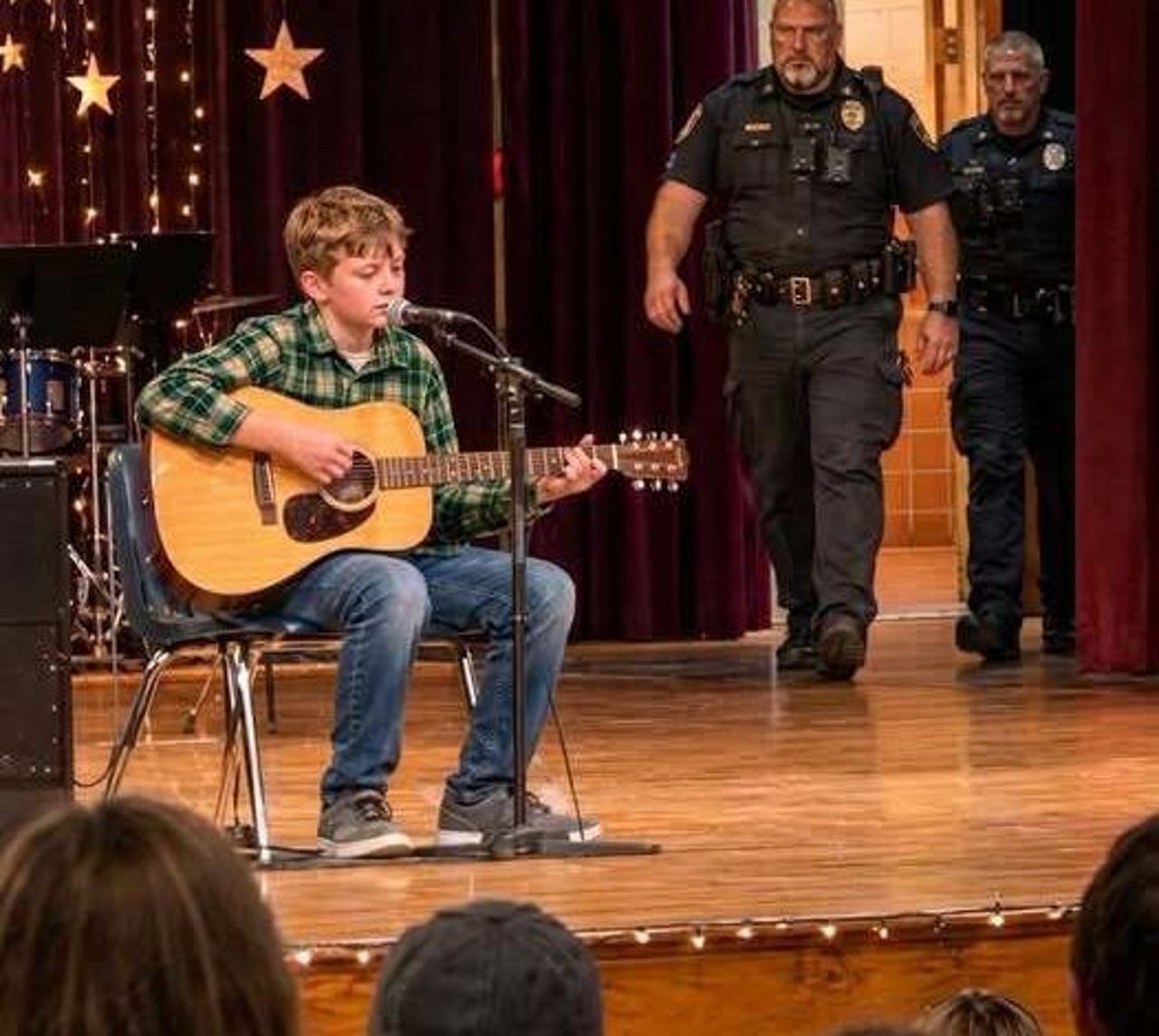
My son was halfway through the second verse. He stood alone on that small stage with his father’s old guitar, his voice thin and trembling but steady enough, and every parent in the room was either in tears or doing everything they could not to be.
Then the doors swung open, and two police officers came in.
Complete uniform. Dark navy. Utility belts, radios, badges glinting in the light pouring through the high gym windows.
I knew that walk. I would know it anywhere. Slow, weighted, deliberate. It’s the walk of someone coming to tell you news you never want to hear.
My entire body turned to ice.
I had spent eleven years of marriage waiting for that walk. Every night David worked late, I lay awake listening for a car in the driveway that wasn’t his. Two officers at the door. Hats in their hands. That image lived in my mind for more than a decade.
And it never happened. Not that way. David didn’t die on duty. He died in a hospital bed set up in our living room, from an illness that took him slowly, piece by piece, over fourteen months.
But my body didn’t know the difference. My body only recognized the walk.
I stood so fast my folding chair tipped backward and crashed onto the floor.
People turned toward me. I didn’t care. My eyes went straight to the stage, to Caleb, because he was the only person left in the world they could possibly be there for.
He had stopped playing.
His fingers were frozen on the strings. His mouth was still parted on the last word he had sung. He was staring toward the back of the gym, and all the color had drained from his face.
The music teacher, Mr. Lowe, lifted himself halfway off the piano bench. Principal Whitfield stepped away from the wall with one hand already raised, like she meant to stop them, or tell them to wait, or ask what in the world they thought they were doing interrupting a Father’s Day assembly in the middle of a grieving boy’s song.
The officer in front removed his hat.
And I recognized him.
Gray at the temples now. Broader than I remembered. The same thick mustache he’d worn since before I knew him.
Ray Delgado.
My husband’s partner for nine years. The man who helped carry David’s casket. The man whose calls I had not returned in nearly three years.
He didn’t look at me. He looked at the stage. At Caleb.
And then he did something I couldn’t make sense of at all.
He nodded at my son. Once. Slowly.
As if he were saying, keep going.
Behind him, the doors opened again.
And this time, it wasn’t only two officers.
To understand why I couldn’t move, why I just stood there with my chair overturned behind me and my hand pressed over my mouth, you need to know how we got there. How my son ended up on that stage by himself. And how badly I had failed him before he ever set foot on it.
My name is Jennifer. My son, Caleb, is twelve.
Three years ago, his father died.
After the funeral, Caleb didn’t cry. Not during the service, not at the cemetery, not later at the house when it was crowded with casseroles and people who had no idea what to say. He sat on the staircase in his small black suit, the one we had bought two days earlier because he had outgrown his church clothes, and he just watched everyone.
When the last guest finally left, I found him still sitting there.
“Do you want to talk, sweetheart?”
He shook his head.
“Do you want to come sit with me?”
He shook his head again.
“Caleb. It’s okay to be sad. It’s okay to cry.”
He looked at me with David’s eyes, brown and solemn, and said, “I know.” Then he went upstairs to his room and shut the door.
That was how it began.
He was nine then. Nine-year-olds are supposed to fall apart. I kept waiting for him to. I read the grief books. I bought the workbook for children with the cartoon bear on the cover. I scheduled an appointment with a kids’ grief counselor, and he went three times and sat on her couch and answered every question with “I don’t know” until she gently suggested maybe we should pause and try again later.
We never did try again later.
He stopped inviting friends over. His best friend, Tyler, used to spend so much time at our house that I kept his favorite cereal on hand. After the funeral, Tyler came by twice, and both times Caleb said he was tired. The third time, Tyler’s mother called to ask if everything was all right, and I told her yes, he just needs some time.
He stopped coming downstairs for dinner on some nights. I would call up the stairs, and he would yell back, “Can I eat in my room?” At first I said no. Then I said all right, just tonight. Then eventually I stopped asking.
His teachers called twice.
The first time was in fifth grade. Ms. Barnes, his homeroom teacher, very gentle, very cautious. “He isn’t disruptive at all,” she said. “That’s kind of the issue. He just isn’t there. He sits in the back and doesn’t raise his hand, and when the other kids are doing group work, he sort of drifts away from them.”
The second time was this year. Seventh grade. A different teacher, but the exact same words. Withdrawn. Quiet. Not participating.
“Is anything happening at home?” she asked.
I wanted to laugh. I wanted to say, his father died, what do you think is happening at home? But all I said was, “We’re working on it.”
We weren’t working on anything. I didn’t know how. I had lost my husband, and somehow in that same year, I had lost my son too, even though he was still right there, eating cereal across the counter from me every morning while staring at his phone.
And lately, it had gotten worse.
That spring, there were entire days when he barely spoke to me at all. Not fighting. No slammed doors. Just silence. I would say good morning, and he would nod. I would ask how school was, and he would shrug.
“How are you doing, bud? Really?”
“Fine.”
It was always fine.
Then one afternoon in May, I found the flyer.
It was crumpled in the bottom of his backpack, under half a granola bar and a library book that was three weeks overdue. I wasn’t snooping. I was looking for the permission slip for his science field trip. But there it was, a sheet of yellow paper, folded into a tight little square.
LINCOLN MIDDLE SCHOOL FATHER’S DAY ASSEMBLY. FRIDAY, JUNE 13. INVITE YOUR DAD, GRANDPA, UNCLE, OR SPECIAL GUY! STUDENT PERFORMANCES AND READINGS. REFRESHMENTS TO FOLLOW.
At the bottom was clip art of a cartoon father and son holding hands.
I sat down on the edge of the kitchen chair and stared at it for a long time.
Father’s Day had always been difficult. The first one after David died, Caleb and I didn’t even mention it. We simply got through the day the way you get through a bad storm, shut inside with the curtains closed, waiting for it to pass. The second year, I took him to the movies to distract him. He sat through the whole thing without touching his popcorn, and in the car afterward he said, “You don’t have to do that, Mom.” The third year was last year. He spent the whole day in his room.
But a school assembly was something else. An assembly meant a gym packed with dads. Every child with someone in the audience. Caleb sitting there with me and an empty chair where his father should have been.
That evening, I placed the flyer on the kitchen table, unfolded and smoothed flat, and waited for him to come downstairs.
He noticed it immediately. He stopped in the doorway.
“You went in my backpack.”
“I was looking for the field trip form.”
He walked over, picked up the flyer, folded it back into that tight little square, and slipped it into his pocket.
“Caleb, we should talk about this.”
“There’s nothing to talk about.”
“It’s a Father’s Day assembly. That’s going to be hard. For both of us.” I tried to keep my voice soft. “I was thinking maybe you could stay home that day. I’ll call the school. No one will think anything of it. We could do something together. Go to the lake, maybe.”
He stayed quiet. He was staring at the floor.
“I want to go,” he said.
“Honey…”
“I want to go.”
“You don’t need to prove anything to anyone. If it’s going to hurt…”
“Mom.” He looked up at me, and for once his face wasn’t empty. There was something underneath it. Something taut and resolute. “I want to go. Okay? Just let me go.”
“Okay,” I said slowly. “Okay. Do you want me to come?”
He hesitated. Then he nodded.
“Yeah,” he said. “You have to come.”
He went back upstairs without eating. I sat alone at the kitchen table and wondered what exactly I had just agreed to.
The next few weeks were strange.
Caleb was quieter than ever with me, but something in the house had shifted. At night, after I had gone to bed, I started hearing something through the wall between our rooms.
Guitar.
Very faint. So faint I thought the first time I must have imagined it. A few notes, then silence. Then those same few notes again. Then silence.
I lay in the dark with my heart pounding.
David had taught Caleb to play when he was seven. They used to sit on the back porch on summer evenings, David with his big old acoustic, Caleb with a cheap little half-size guitar we bought from a pawn shop, and David would teach him chords one by one. G. C. D. Caleb’s fingers were too small and he would get frustrated, and David would laugh and say, “Everybody’s fingers hurt at first, bud. That’s how you know you’re learning.”
When David became too sick to hold the guitar anymore, he gave it to Caleb. His own guitar. The big one, with a crack near the bottom that David had glued himself years earlier, and his initials scratched inside the sound hole.
Caleb put it in the back of his closet the week after the funeral. I hadn’t heard him play it once since then.
Now, every night, those same few notes through the wall.
One night I got out of bed and stood outside his door. The playing stopped immediately, as though he could sense me there. I lifted my hand to knock. Then I let it fall and went back to bed.
I told myself I was giving him space. That was what the books said. Give them space. Let them come to you.
But if I’m honest, I was afraid. I was afraid that if I opened that door, I would hear the song I thought I was hearing. And I wasn’t sure I could survive that.
There were other odd things too.
One Saturday, Caleb asked if he could walk to the library by himself. He never went to the library. He came home three hours later, and when I asked what book he had checked out, he said they didn’t have it.
Another evening, I came into the kitchen and found him on the house phone, the old landline we never used anymore. He hung up so fast he nearly dropped it.
“Who was that?”
“Nobody. Wrong number.”
“You were talking to a wrong number?”
“They were asking for somebody. I told them they had the wrong number.”
He went upstairs. I stared at the phone for a long time. I almost checked the call history. Then I didn’t.
And about a week before the assembly, my cell phone rang while I was at work.
I looked at the screen.
RAY DELGADO.
I had never deleted his number. I had thought about it. I had thought about it many times. But every time, my thumb would hover there and I couldn’t make myself do it.
I let it ring.
A minute later, the voicemail icon appeared.
I didn’t listen to it. I never listened to his voicemails. There were eleven of them on my phone, spread over three years. Birthdays. Holidays. The anniversary of David’s death. I had never opened a single one.
I turned the phone facedown on my desk and went back to work.
If I had listened to that one, everything would have been different. Or maybe not. Maybe it would have been exactly the same, except I would have known. And I would have taken that moment away from my son.
I will never know which.
David was a police officer for sixteen years.
People hear that sometimes and picture something dramatic. He wasn’t like the cops on television. Mostly he worked patrol in our part of town, which is quiet. He helped elderly women look for missing cats. He broke up bar fights on Friday nights. He gave the same kids the same lecture about skateboarding in the bank parking lot roughly four hundred times, and he knew every one of them by name.
He was big and slow-moving and gentle, with a laugh you could hear from the next room. He was a terrible cook but made the exact same thing every Saturday morning: pancakes, too thick, a little burned on the bottom. And while he made them, he hummed.
It was always the same song. He had made it up himself years before Caleb was born, on a long night shift when he was bored and missing me. It didn’t have a proper title. We just called it the Saturday song.
It began as humming. Then, over the years, words were added. Some were David’s. Some were mine. Some Caleb invented when he was four and insisted had to stay, which is why the second verse includes a line about a dog named Pickles that we never actually had.
I’ll tell you the chorus, because it matters.
Hold the light, hold the light,
I’ll be home before the night.
If you can’t see me, look up high,
I’m the one who waves goodbye.
It’s not poetry. David would have been the first person to say so. But on Saturday mornings, in our little yellow kitchen, with the pancakes burning and Caleb standing on a chair to help flip them, it was the most beautiful song in the world.
And the men at the station knew it too. That was the part I hadn’t thought about in three years.
David sang it during night shifts in the patrol car. He sang it in the break room. He sang it so often the other officers began by teasing him about it, then they started joining in, and eventually it simply became a thing. When someone had a rough night, somebody would start humming the Saturday song. When the department had its holiday party, David would get up at the end with his guitar and they would all sing it, a group of tired cops in ugly sweaters, arms hooked around each other’s shoulders, wildly off-key.
Ray Delgado was his partner. Ray was shorter than David, lean, with a mustache and a temper and two daughters he talked about all the time. They were the kind of partners who finished each other’s sentences and argued about baseball for eight straight hours. Ray came to our house for dinner every other Sunday for nine years. He taught Caleb how to throw a curveball. He was Caleb’s godfather.
When David got sick, Ray was there.
He drove David to treatments when I couldn’t get off work. He sat in hospital waiting rooms through every surgery. Near the end, when David was in the hospital bed we had set up in our living room, Ray came by almost every night after his shift. Still in uniform. He would sit beside the bed and talk to David about nothing, about baseball, about who had done what ridiculous thing at the station, even when David could no longer answer.
And the others came too. Big men in uniform filling my living room, bringing food, mowing the grass, fixing the gutter that had been leaking for two years. My house was full of blue for months.
At the funeral, there were more than two hundred officers. Some from other towns, some from other states. They lined the road to the cemetery. They played bagpipes. They folded the flag into a tight triangle and a young officer I didn’t even know knelt in front of me and handed it to me and said something I don’t remember.
Caleb sat beside me and watched all of it without crying.
And then, afterward, something in me broke.
I can’t explain it any better than that. For sixteen years, those uniforms had meant fear to me. Every shift, every late night, every siren in the distance. For fourteen months, they had meant sickness. Officers in my living room meant my husband was dying. And on the day of the funeral, a sea of blue meant he was gone.
I couldn’t bear to look at them anymore.
Ray kept coming by. Every Sunday, for a while. He’d bring a casserole his wife had made or a pizza, and he would ask if Caleb wanted to go throw the ball around. The other guys called too. Invitations to barbecues. The department softball game. The holiday party. Someone offered to take Caleb to a baseball game.
I said no to everything.
“He’s not ready.”
“We’ve got plans that day.”
“Maybe next time.”
And then one Sunday, around four months after the funeral, Ray showed up at the door with a baseball glove tucked under his arm. A new one. Caleb’s size.
“Thought he might be outgrowing the old one,” he said.
I stood in the doorway and didn’t let him inside.
“Ray,” I said. “I need you to stop coming.”
He blinked. “Jen…”
“I can’t do it anymore. Every time I see you in that uniform, I…” My voice cracked. “I just can’t. I need it to be over. Please. I need you to let us move on.”
He looked at me for a long moment. He had the glove in his hands, turning it over.
“He’s my godson,” he said quietly. “I promised David.”
“David’s gone.”
It came out much harsher than I intended. Ray actually flinched, as if I had struck him.
He set the glove down on the porch step very carefully. Then he put his hat on and walked back to his car.
I shut the door and leaned against it and slid to the floor.
When I looked up, Caleb was sitting at the top of the stairs.
I don’t know how long he had been there. Long enough. He looked down at me, and I waited for him to say something. To ask why. To be angry.
He didn’t say anything at all. He just stood up and went back to his room.
The next morning, the glove was gone from the porch step. I never asked what became of it. I assumed Caleb had thrown it away.
That was almost three years ago. And slowly, everything went quiet. The barbecue invitations stopped. The phone calls became once a year, on the anniversary and on Caleb’s birthday, and I never answered those either.
I told myself we were moving on.
What I was really doing was locking both of us inside a very small, very quiet house.
The morning of the assembly, Caleb came downstairs wearing a button-up shirt.
A real one. Light blue, with a collar. I didn’t even know he had it. It was a little too wide in the shoulders, and the sleeves had been rolled up twice.
It took me a second to place it.
It was David’s.
I stood at the counter with the coffee pot in my hand and couldn’t speak for a moment.
Caleb poured himself cereal as if nothing at all was unusual. He didn’t look at me.
“That’s Dad’s shirt,” I said at last.
“Yeah.”
“Where did you get it?”
“The box in the garage.”
I had packed all of David’s clothes into boxes about a year after he died. I couldn’t donate them and I couldn’t look at them, so they had sat in the garage under a tarp ever since.
“It looks nice on you,” I said, and my voice did something strange halfway through.
He shrugged. But I saw his ears turn a little pink.
Then I noticed what was leaning against the wall by the front door.
The guitar case.
David’s guitar case. Black, scuffed, with a gas station sticker from Tennessee that David had always meant to peel off and never did.
“Caleb,” I said carefully. “Are you doing something today? At the assembly?”
He took a long time chewing his cereal.
“Maybe,” he said.
“Maybe?”
“I signed up. Mr. Lowe said I could.” He set his spoon down. “I don’t know if I’ll actually do it. I might chicken out.”
“What are you going to play?”
He looked at me. Then he looked away.
“You’ll see.”
I wanted to push. I wanted to say, please tell me, please let me be prepared. But something in his face stopped me. He was holding himself very carefully, like a glass filled all the way to the rim.
“Okay,” I said. “You’ll be great.”
“You don’t know that.”
“I know you.”
He almost smiled. Then he picked up his bowl, set it in the sink, grabbed the guitar case, and went out to the car.
The gym at Lincoln Middle School smelled like floor wax and coffee. Rows and rows of folding chairs had been set up, and a long table stood in the back with doughnuts and juice boxes. A banner hung above the stage, made by the sixth-grade art class. HAPPY FATHER’S DAY in large, uneven letters, with handprints all around the border.
The gym was packed.
Dads everywhere. Dads in work clothes who had clearly slipped out of the office. Dads in sweatpants. Grandfathers with canes. A few uncles. A tall man in a construction vest with his son on his shoulders even though the boy was obviously too old for that.
I found two seats near the middle. Caleb went to sit with his class at the front near the stage, the guitar case at his feet.
I sat down. The chair beside me was empty.
A man came down the row and stopped. “Is this seat taken?”
“Yes,” I said, too fast. Then I felt foolish. “I mean… no. Sorry. It’s not.”
He sat down. He was maybe forty, with a sunburned neck and a kind face. His daughter waved at him from the front row, and he waved back with his whole arm like she was boarding a plane.
“Which one’s yours?” he asked.
I pointed. “Blue shirt. Next to the guitar.”
He looked. “Ah. He playing something?”
“I think so. He won’t tell me what.”
“Teenagers,” he said with a laugh. “My girl’s reading a poem. She made me swear I wouldn’t cry.” He held up a pack of tissues from his jacket pocket. “I came ready.”
I laughed too, a little. Then he said, kindly, just trying to make conversation, “Dad couldn’t make it?”
I felt the question hit my chest.
“He passed away,” I said. “Three years ago.”
The man’s face dropped. “Oh. Oh, I’m so sorry. I didn’t…”
“It’s okay. You didn’t know.”
He was quiet for a moment. Then he did a very simple thing. He reached over and squeezed my hand once, quick and awkward, the way someone might squeeze a stranger’s hand at a funeral. Then he let go and turned back toward the stage and said nothing else.
I have thought about that man many times since. I never even learned his name.
The assembly began.
Principal Whitfield gave a short speech about fathers and father figures and the important men in our lives. A sixth-grade boy read a poem about his dad’s truck. Two girls performed a skit with a fake mustache that made the whole gym laugh. A shy boy played a trumpet song so loudly that a baby in the back started crying.
Every time a kid finished, they looked out into the audience. And every time, some dad was waving back. Or wiping his eyes. Or standing to clap.
I watched Caleb watching them.
He sat very straight in his chair. He didn’t laugh at the skit. He didn’t turn around to look at me. He just watched each kid finish and each dad stand up, one after another, with that same look on his face like a glass of water filled too carefully.
I almost went up there and took him home. I truly almost did. I had my purse in my lap and my hand on the strap.
Then Mr. Lowe stepped up to the microphone.
“Our next performer is Caleb Morrison, from Ms. Patterson’s seventh grade class.”
Caleb stood up.
He picked up the guitar case and walked up the stage steps. Alone. He didn’t look at anyone.
He knelt and opened the case. He took out David’s guitar, the big old acoustic with the glued crack near the bottom, and slipped the strap over his shoulder. It was too large for him. The body of the guitar nearly covered his entire chest.
Mr. Lowe brought over a stool. Caleb shook his head. He wanted to stand.
My heart was in my throat. I hadn’t known he was planning anything until that morning. I hadn’t seen him hold that guitar in three years. And now my son was standing in front of four hundred people in his dead father’s shirt, holding his dead father’s guitar.
He stepped up to the microphone. It was set too high. Mr. Lowe hurried over and lowered it.
Caleb looked out at the audience.
He searched for a second. Then he found me. Our eyes met. I gave him the smallest nod I could manage, because I didn’t trust myself to do anything bigger.
Then he looked upward. Not at the audience. Up. Toward the high gym ceiling, toward the metal beams and the old lights in their cages.
“This one’s for my dad,” he said softly.
The microphone caught it. The entire gym heard.
And then he began to play.
The first notes were the ones I had been hearing through the wall at night. G. C. G. D. Slow. I knew them before the first chord had finished ringing.
I clapped my hand over my mouth.
He started singing.
His voice was quiet at first, so quiet you had to lean in to hear it. It cracked on the second line. He stopped, swallowed, and kept going.
Saturday morning, kitchen’s warm,
pancakes burning, here’s the storm.
Little hands upon the pan,
I’m the luckiest in the land.
It was the Saturday song.
The one David had hummed every Saturday of Caleb’s life. The one I had not been able to hear since the funeral. The one I had shut off in my own mind every time it started, because hearing it felt like someone opening my chest.
Caleb was singing it for four hundred strangers.
The man next to me already had his tissues out. I heard someone behind me whisper, “Oh no,” in that soft way people do when something is about to break their heart.
Caleb made it through the first verse. His fingers slipped on one chord and it buzzed, and he winced, and kept going.
Then the chorus.
Hold the light, hold the light,
I’ll be home before the night.
His voice shook on the word ho…