“I made a promise to your daughter. And now you deserve to know the truth.”
The woman beside Teagan’s headstone extended a sealed envelope toward me.
My name was on the front. Mom. In handwriting I had not seen in ten years.
My daughter’s handwriting.
For a second, I forgot how to breathe.
It was a Saturday in early April, one of those bright, windy days. The kind of spring afternoon when the sunlight feels warm but the air still bites. Oak Grove Cemetery sits up on a hill on the north side of Springfield, Missouri, and the wind rolls over that hill and presses against you like it has somewhere urgent to be.
In my hands was a bouquet of yellow tulips from Hy-Vee. Teagan’s favorite. Every year on her birthday, I bring yellow tulips.
She would have turned twenty-nine.
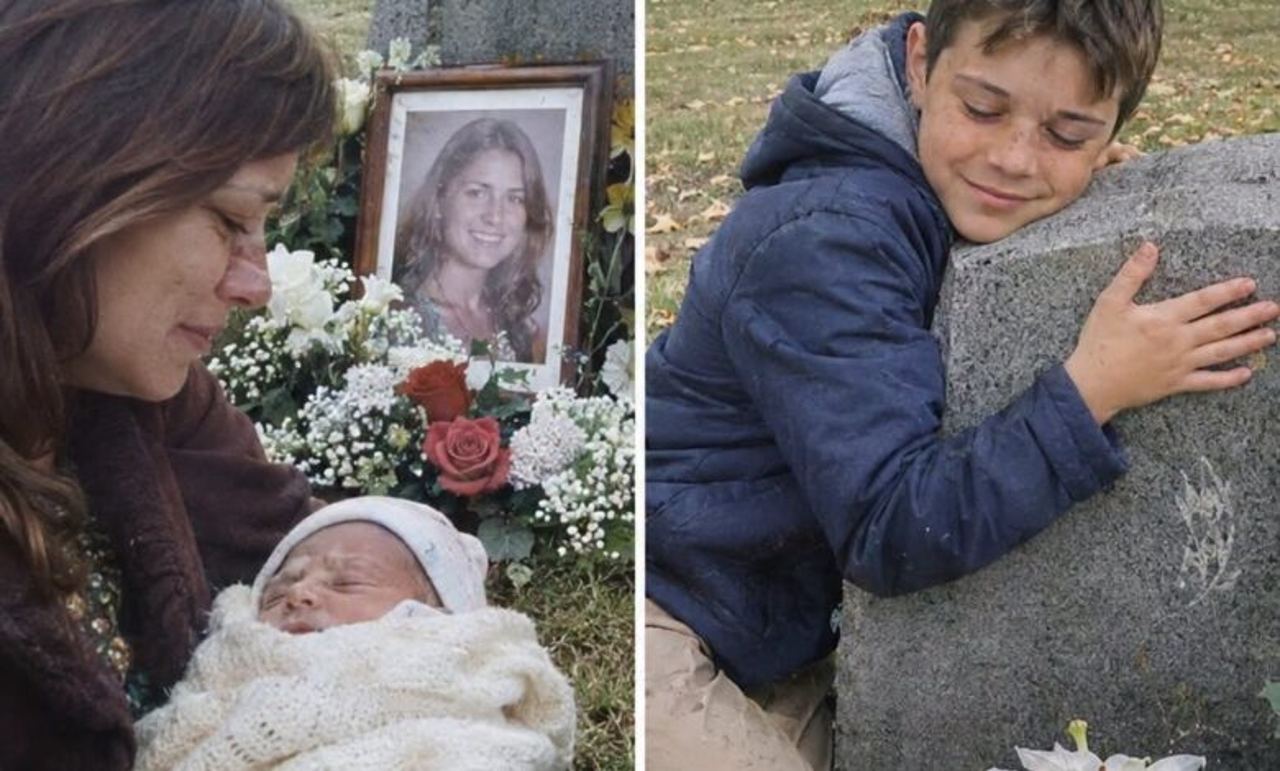
I hadn’t seen the woman at first. Lucas and I had parked near the bottom of the hill by the old stone chapel, and he had stopped to rummage through the back seat because he couldn’t locate the card he had made. I went on ahead without him.
When I reached the top, she was already there.
Probably in her sixties. Short gray hair. A navy raincoat. Practical shoes. She stood at the foot of Teagan’s grave with her hands clasped in front of her, looking down at the marker.
TEAGAN MARIE DAWSON. APRIL 6, 1997 – APRIL 2, 2016. BELOVED DAUGHTER. MOTHER.
I had paid extra to include that last word. The man at the monument company asked whether I was certain. She had only been a mother for forty minutes.
I told him I was certain.
The woman lifted her eyes when she heard my shoes on the gravel.
She did not smile. She studied me for a long moment. Then she slid a hand into the pocket of her raincoat and pulled out the envelope.
“Where did you get that?” I asked.
“She gave it to me.”
“When?”
“The day her baby was born.”
I gripped the tulips harder. The plastic wrapper crackled in my hand.
I could not make sense of what I was hearing.
“You’ve been holding a letter from my daughter,” I said carefully, “for ten years?”
The woman lowered her gaze to the grass.
“Yes,” she said.
Before I could say another word, Lucas shouted from the bottom of the hill.
“Grandma! I found it!”
My grandson came racing up the gravel path toward us. Ten years old. Thin legs. Grass-stained jeans. His Cardinals cap turned backward. He was waving the birthday card over his head like a banner.
He had made it himself at the kitchen table the night before. Purple construction paper folded in half. HAPPY BIRTHDAY MOM written in green marker across the front, along with a drawing of a baseball diamond and a stick figure with long brown hair standing in the outfield. He had spent forty-five minutes making it. He would not let me look inside.
The woman glanced in his direction.
Her expression shifted. Something tender and sorrowful passed over it.
Then she faced me again.
“Don’t open this in front of him,” she said softly.
“Who are you?” I asked.
“My name is Trudy.”
“That doesn’t tell me anything.”
She held my gaze for a long second.
“I knew Teagan at the hospital,” she said. “I was her nurse.”
A sour feeling dropped into my stomach.
The hospital.
Mercy Hospital. Fourth floor. Labor and delivery. The waiting room with the blue chairs and the television bolted to the wall, showing a home improvement program with the sound turned off.
The doctor in green scrubs who came and sat beside me.
Lucas was halfway up the hill now, still brandishing the card.
Trudy pressed the envelope into my hand. Firmly. She folded my fingers over it.
“My number is on the back,” she said.
Then she turned and walked away. Down the far side of the hill. Toward the distant gate. Without saying anything else.
I stood there with the envelope in one hand and the tulips in the other.
My hands were trembling.
“Grandma?” Lucas was breathing hard. “Who was that?”
I slipped the envelope inside my coat.
“Nobody, sweetheart,” I said. “Just someone paying a visit.”
He looked at me. Then at the woman leaving. Then back at me.
He did not believe me.
He never does. He is too much like his mother.
Teagan was eighteen when she told me she was pregnant.
It was August of 2015. A Tuesday evening. I was standing at the kitchen sink doing the dishes after supper. She was at the table behind me with her chemistry book open, supposedly studying for a summer class at Ozarks Technical Community College.
“Mom,” she said. “I need to tell you something.”
“Mm-hmm.”
“I’m pregnant.”
I dropped a plate.
It didn’t shatter. It just clanged into the sink. I stood there with my hands in the sudsy water and did not turn around.
“How far along?” I asked.
“Fourteen weeks.”
Fourteen weeks.
She had known for two months. Maybe longer. And every night she had been sitting across from me at that table, eating my meatloaf, asking me to pass the salt.
I turned around.
She was sitting very straight in her chair with both hands flat on the textbook. Her face was pale. Her eyes were red. She had been crying before she came downstairs. She had tried to cover it.
She looked so young.
She looked maybe twelve.
“Who’s the father?” I asked.
That was the first thing I said.
Not “Are you okay?” Not “Are you frightened?” Not “How are you feeling?”
Who’s the father.
I have thought about that many times since.
All through her pregnancy, I kept asking about the baby’s father again and again.
At breakfast. In the car. At doctor visits. In the grocery store.
“Does he know?”
“Mom, please.”
“What’s his name?”
“I can handle this myself.”
“You shouldn’t be doing this alone.”
“Please stop making this harder.”
Every conversation became another fight.
She would go upstairs and shut her bedroom door. I would stand outside in the hallway. Sometimes I knocked. Sometimes I only stood there.
Eventually neither of us knew how to talk about it without wounding each other.
So we stopped talking about it.
Mostly.
I want to explain why I asked so often.
Not to excuse myself. Only to explain.
Teagan’s father left when she was two.
His name was Gary Dawson. We had been married four years. He was a long-haul truck driver. One day in March of 1999 he left on a run to Dallas and never returned. He called me from a pay phone in Texarkana three days later and said he had met someone. He said he was sorry. He said he would send money.
He sent money twice.
Then nothing.
I raised Teagan alone.
I worked as a medical receptionist at a family practice on Battlefield Road for twenty-two years. I picked up Saturdays at a craft store for extra money. I bought her school clothes at Goodwill and told her they were vintage. I learned to fix a toilet and change a tire and destroy a wasp nest with hairspray and a lighter.
I did everything on my own.
And I never wanted that life for her.
So when she told me she was pregnant, all I could think was: Not her. Not my daughter. She is not going to face this by herself. I’m going to find that boy and make him step up if it’s the last thing I do.
I believed I was protecting her.
I believed that was what love looked like.
There was a boy who came to our house twice that fall.
I barely remember him. Tall. Thin. Dark hair hanging in his eyes. A letterman jacket from Glendale High School, which was not Teagan’s school.
The first time was in September. He sat at our kitchen table with a can of Sprite and kept turning it over in his hands while Teagan finished getting ready. He said “Yes, ma’am” and “No, ma’am” and almost nothing else. Then they left. To a movie, Teagan said.
The second time was in October. He came to the front door. Teagan met him out on the porch. They stood there talking in the cold for half an hour. I watched them through the living room curtain. At one point, he placed his hand on her stomach.
Then he left.
When she came back inside, I said, “Is that him?”
“Who?”
“Don’t play games with me, Teagan. Is that the father?”
She looked at me for a long time.
“He’s a friend,” she said.
And she went upstairs.
I never saw him again.
I never asked his name.
I didn’t think he mattered. I thought he was just some boy.
She went into labor on April 2, 2016. Four days before her nineteenth birthday.
It was early morning. Five-thirty. She came into my bedroom, woke me, and said, “Mom. I think it’s time.”
I drove her to Mercy. She held my hand the entire way and squeezed so hard during the contractions that my knuckles were bruised for a week.
She was scared. I could see it. Her face had gone gray.
But she kept joking anyway.
“If I die,” she said at a red light on Glenstone, “you can’t give my room to the cat.”
“You are not going to die.”
“Promise you won’t give my room to the cat.”
“Tee. We don’t even have a cat.”
“You’ll get one,” she said. “I know you. You’ll get lonely and get a cat and give it my room.”
I laughed.
I laughed.
They took her back to labor and delivery. A nurse with a clipboard asked me to wait in the family waiting room while they got her settled. “Just a few minutes,” she said. “We’ll come get you.”
I sat in that waiting room for three hours.
They brought me back twice. Once at eight. Once at ten. I sat with Teagan and held her hand and fed her ice chips. She was hurting badly. They gave her an epidural. She slept for a little while.
At eleven-thirty, a nurse asked me to step out again. They were going to check her. Things were moving. It was nearly time.
I kissed Teagan on the forehead.
“I’ll be right outside,” I said.
“I know,” she said.
Those were the last words she ever spoke to me.
I know.
At one-fifteen that afternoon, a doctor came into the waiting room and sat down beside me.
He was young. In his thirties. Green scrubs. A surgical cap with little cartoon bears on it. His mask was hanging around his neck.
He sat in the blue chair next to mine. For a moment, he said nothing.
I knew.
I knew before he ever opened his mouth.
“I’m so sorry,” he said. “We did everything we could.”
I could not understand what he was saying.
The words just hung in the air. They meant nothing. It was like listening to someone speak another language.
He said many things after that. Amniotic fluid embolism. Extremely rare. Sudden. Her heart. They tried for forty minutes. Nothing anyone could have predicted. Nothing anyone could have prevented.
I remember very little of it.
I remember asking one question.
“The baby?”
“He’s alive,” the doctor said. “He’s healthy. Seven pounds, one ounce.”
He rested his hand on my arm.
“He’s going to need you,” he said.
Teagan never came home from that hospital.
Her son came home with me instead.
I named him Lucas. Teagan had chosen it. She had written it on a sticky note on the refrigerator in February. LUCAS JAMES? With a question mark. Then underneath, in a different ink color, she had crossed out the question mark.
So he was Lucas James.
James was my father’s name.
No father was listed on the birth certificate.
The hospital asked me. I said I did not know.
That was the truth.
For the next ten years, Lucas and I became our own little family.
I won’t pretend it was easy.
I was forty-five with a newborn. A colicky newborn. He screamed every evening from nine until midnight for three straight months. I walked him up and down the hallway until my feet throbbed. I sang him every song I knew. Most of them were Patsy Cline songs.
I took six weeks away from work. Then I returned. My church friend Carol watched him during the day for next to nothing.
I was so exhausted I nodded off at red lights.
I was so heartsick I cried in the shower every morning so he would not hear me.
But he grew.
He grew into a thoughtful, curious boy. The kind who asks questions no one can answer. “Grandma, where does the wind begin?” “Grandma, do fish get thirsty?” “Grandma, if you dig a hole all the way through the Earth, do you fall out on the other side or get stuck in the middle?”
He loved baseball more than anything. He would play catch against the side of the garage for hours. Thunk. Thunk. Thunk. Until the neighbors complained.
He loved my Sunday pancakes. Every Sunday morning since he was two. Buttermilk pancakes with real maple syrup. He would eat four. He would eat five if I let him.
He had Teagan’s eyebrows. Dark, straight, and so serious. And her nose, which tipped up just a little at the end.
When he concentrated, he stuck his tongue out at the corner of his mouth.
Teagan used to do that too.
But there was one question he kept asking that I could never answer.
The first time, he was four. We were at the park. Another little boy’s father was pushing him on the swings. Lucas watched them for a long while.
Then he looked up at me.
“Grandma,” he said. “Who’s my dad?”
“I don’t know, sweetheart.”
He asked again at six. At seven. At eight. At nine. Every Father’s Day, when the other children at school made cards. At his first Little League game, when the coach asked all the dads to come out for a picture.
“Grandma, who was my dad?”
“I don’t know.”
It was the truth.
But after a while, it began to feel like a lie.
Now, with Teagan’s envelope tucked inside my coat, I was afraid that learning the truth might hurt more than not knowing it.
Lucas leaned his card against the headstone. He made me promise not to read the inside. Then he talked to his mom for a little while, the way he always does. He told her about baseball tryouts. About his spelling test. About how Grandma made the pancakes too thick again last Sunday.
I stood a few steps back and let him.
I could feel the envelope pressing against my ribs the whole time.
When we got home, I hid the letter in a kitchen drawer.
The junk drawer. Beneath the takeout menus and rubber bands and batteries that might already be dead.
Lucas dropped his backpack by the dining room table.
“Who was that lady?” he asked.
“Someone who knew your mom.”
His face brightened instantly.
“Really? What did she say?”
“Not much.”
“Did she know my dad?”
I shoved the drawer closed. Probably harder than I meant to. The rubber bands rattled inside.
“I don’t know,” I said.
Lucas looked at my face.
“You always say that,” he said.
“Because it’s something I truly don’t know, my love.”
He went quiet.
He looked down at the floor. His jaw tightened.
That expression reminded me so painfully of Teagan. The way she would go still and silent when things became difficult. The way she would fold inward and close some invisible door.
“Okay,” he said.
Then he went into the living room and turned on the TV.
After Lucas went upstairs to bed, I took the envelope back out of the drawer.
I stood at the kitchen counter holding it for a long time.
The kitchen was still. The refrigerator hummed. The clock over the stove ticked. It was nearly ten-thirty.
On the front, written in blue ballpoint: Mom.
On the back, in a different hand, small and neat: Trudy Pell. And a phone number.
I turned it over and over in my hands.
I was afraid.
I had waited ten years to know. I had prayed to know. And now that the answer was in my hands, I didn’t want to open it.
What if it said something I could not survive?
What if she hated me?
At last, I broke the seal.
A photograph slipped out onto the counter.
It was a small one. A four-by-six drugstore print, the kind you used to pick up from Walgreens. The colors had faded a little.
Teagan was standing in a park. Phelps Grove Park, I think. Near the duck pond. She was wearing her old gray Missouri State hoodie and jeans. She was laughing at something.
Standing next to her was a teenage boy.
Tall. Thin. Dark hair hanging in his eyes.
I knew him.
The boy from my kitchen table. The one with the can of Sprite.
There was an old baseball glove tucked under his arm.
Brown leather. Worn and cracked. Frayed laces.
My hands were shaking.
I picked up the letter.
It was one page. Notebook paper. Folded into thirds. Torn from a spiral along the edge.
I unfolded it.
Mom,
I know you think I won’t tell you because I don’t trust you.
That isn’t why.
He knows about the baby.
I stopped reading.
My fingers were trembling so hard the paper made a sound.
He wanted to stay. But wanting something and being ready for it aren’t the same thing.
His family keeps telling him this will ruin everything he planned. College. Baseball. All of it. I told him not to come back because he’s scared of disappointing them. If he comes back, I need it to be because he chooses us himself. Not because I made him. Not because you made him. Because he chose.
I know you’d make him. I know you’d find him and drag him here by his ear. I know you would because you love me.
But I don’t want a boy who was dragged here.
I want someone who walks in the door on his own.
Then I reached the sentence that shattered everything I thought I knew about those final months.
You kept asking me who he was. But you never asked why I was scared.
I set the letter down on the counter.
I braced both hands flat on either side of it and leaned forward, because my legs were no longer doing a very good job of holding me up.
And suddenly a moment I had completely forgotten came back to me.
All at once. Like a door flying open.
It was January. 2016. Three months earlier.
A Thursday night. I was at the kitchen table paying bills. The electric bill. The water bill. The hospital pre-registration forms. I had a calculator, a stack of envelopes, and a cup of tea gone cold.
Teagan came into the kitchen. Seven months pregnant. In her pajamas. Her hair pulled into a messy bun.
She stood by the refrigerator.
“Mom,” she said. “Can I ask you something?”
I did not even look up.
I was adding a column of numbers. I was tired. I had worked ten hours that day. My back ached.
“If this is about avoiding the father question again,” I said, “I can’t do this tonight, Tee.”
She stood there.
She did not move.
For several seconds, she said nothing at all.
Then she said, very softly, “Never mind.”
And she went upstairs.
I had forgotten it.
Completely. For ten years. It had simply drifted away, like a thousand other small moments.
For ten years, I had told myself that my daughter would not confide in me. That she had shut me out. That she had been too proud, or too stubborn, or too ashamed.
Now I wondered whether I had been the one who shut the door.
I called the number on the back of the envelope that very moment.
It was ten-forty at night. I did not care.
Trudy answered on the fourth ring.
“Hello?”
Her voice sounded sleepy. I had woken her.
“You kept this for ten years,” I said.
There was a pause.
“Elizabeth,” she said.
“You kept my daughter’s letter for ten years.”
“I know.”
“Don’t say that to me as if it’s perfectly acceptable.”
She did not respond.
I could hear her breathing through the line.
“Meet me,” I said.
“Elizabeth, I—”
“Tomorrow. You owe me that.”
There was a long silence.
“Lindberg’s Diner,” she said. “On Commercial Street. Two o’clock.”
The next day, Trudy was waiting in a booth near the back of the diner.
Lindberg’s is an old place. Red vinyl booths. A pie case by the register. A waitress named Pam who has been there since the 1980s and calls everyone honey.
Trudy sat with a cup of coffee in front of her that she had not touched. She wore the same navy raincoat. She stood when she saw me. Then she sat down again.
I did not sit immediately.
I took the photograph from my purse. The one of Teagan and the boy by the duck pond.
I placed it on the table between us.
Then I sat down.
“You took care of Teagan?” I asked.
“For part of that day.”
“Then why did she give you the letter? Why not me?”
Trudy stared at the photograph for a long time.
“She was scared,” Trudy said. “She didn’t think she was going to die, Elizabeth. She was eighteen and about to have a baby.”
That hit me hard.
I had always imagined the letter as some kind of farewell. A final message from my daughter. As though she somehow knew.
But she didn’t know.
She knew no more than I did.
She was only a frightened young girl about to become a mother, and she wanted to make sure that if something went wrong, somebody would know the truth.
“She wrote it early that morning,” Trudy said. “Around seven. Before the epidural. You had gone down to the cafeteria for coffee. She asked me for paper. I tore a sheet from my notebook.”
She swallowed.
“She told me that if something went wrong and he didn’t come, I should give the letter to you. She was very clear about that. If something goes wrong and he doesn’t come.”
I pointed at the boy in the picture.
“Is this him?”
“I don’t know his name,” Trudy said. “She never told me.”
“Then what do you know?”
Trudy hesitated.
“She talked about him,” she said. “Not much. But enough. She said he was kind. She said he was scared. She said his parents had big plans for him and she didn’t want to be the reason those plans collapsed.”
I stared at the photograph.
“Do you know where he is now?”
“No,” Trudy said. “I held onto that letter for ten years because she asked me to. I never tried to find him. That was not my place.”
I left the diner with more questions than answers.
But now I had a face.
And a glove.
I began to search.
It took weeks. School yearbooks. Old newspaper stories about high school baseball. Social media. A few careful phone calls to people who might have known somebody from Glendale High around 2015.
I found him.
His name was Jesse. Jesse Carter.
He lived in Mount Vernon, about forty minutes away. He worked in a hardware store. He was thirty. Unmarried. No children listed anywhere.
I sat in my car outside the hardware store for a long time before going in.
He was behind the counter. Taller than I remembered. Broader through the shoulders. The dark hair still fell into his eyes a little.
He looked up when the bell over the door rang.
For a moment, he looked at me the way you look at any customer.
Then his face changed.
He knew.
“Elizabeth,” he said.
My name. He remembered my name.
“Jesse,” I said.
He came around from behind the counter.
We stood there in the middle of the aisle between the paint and the power tools.
“I got a letter,” I said. “From Teagan. After all this time.”
His eyes filled with tears.
“She wrote one?”
“She did.”
I did not show it to him. Not then.
“I need to know,” I said. “Why you never came.”
He looked down at the floor.
“I was eighteen,” he said. “My parents… they said if I stayed, if I became a father at eighteen, everything would be over. College. The scholarship. Baseball. They said I’d be throwing my whole life away. They said Teagan would be better off without me dragging her down.”
“And you believed them.”
“I was scared,” he said. “I loved her. I wanted the baby. But I listened to them instead of listening to her.”
He lifted his eyes to me.
“I went to the hospital,” he said. “April 2. I bought flowers. Pink carnations. I stood in the parking lot for an hour. I made it all the way to the elevators. Then I left.”
I felt something cold settle inside my chest.
“You were there.”
“I was there,” he said. “And I left. And I have regretted it every day since.”
He wiped his face with the back of his hand.
“I found out she died from a friend of a friend. Two days later. I went to the funeral. I stood in the back. I saw you. I saw the baby. And I still didn’t come up to you.”
“Ten years,” I said.
“Ten years,” he said.
We stood there in silence.
“I’m not asking you to forgive me,” he said. “I’m not asking for anything. I just… if he ever wants to know. If Lucas ever wants to know who I am. I’ll be here. I’ll answer every question. I’ll take whatever he wants to give me. Or nothing.”
I looked at him for a long time.
“You’re twenty-eight years late,” I said. “But you do get a chance to decide what kind of man you’re going to be now.”
He sat there with his coffee cup. (By then we had moved to a coffee shop.)
He had stopped turning it in his hands.
“Yes, ma’am,” he said.
On the drive home, I had to pull over.
At a rest stop on I-44 near Halltown. I sat in my car between two semis and lowered my head onto the steering wheel.
I didn’t cry. That surprised me.
I just sat there.
I thought about Gary. Calling me from a pay phone in Texarkana. Saying he would send money.
I thought about how I had spent twenty-seven years trying to make sure no man would ever do that to my daughter again. How I had asked and asked and asked. Who’s the father. What’s his name. Does he know.
And how not once had I asked her the question that mattered.
Why are you scared, baby?
She had been afraid of the very same thing I was.
Of being with someone who did not choose her.
Two days later, I found an envelope on the front porch.
Plain white. No stamp. Tucked into the screen door.
Written across the front in neat block letters: LUCAS.
I did not like the idea of reading his private mail.
But he was ten. Protecting him was still my job.
I sat at the kitchen table and opened it.
It was three pages long. Handwritten. Blue ink. Lined paper.
I read every word twice.
One sentence stood out from all the rest.
I was scared when I was eighteen, but being scared doesn’t explain ten years.
There were no demands for forgiveness. No excuses. No blaming anyone else.
He wrote about Teagan. About the dock at Table Rock Lake. About the bread and the fish. …