The Pink Heart Ring
I’m the pastor of a small neighborhood church in Springfield, Missouri. Grace Community Methodist, at the corner of Kearney and National, with a white steeple that tilts just slightly to the left and a congregation of around ninety souls on a good Sunday. I have served there for twenty-six years.
Three or four times each week, I go to the hospital. St. Luke’s, on the south side of town, the large brick one with the helicopter pad on top. Most often, I visit the oncology floor and the hospice wing, sitting with people who are nearing the end of their lives. Some of them want prayer. Some want conversation. Some simply want someone to hold their hand who isn’t weeping.
I’ve been doing that for twenty years. I’m sixty-three now. I’ve held more hands at the end than I could ever count.
On a Tuesday afternoon in March, Denise, the charge nurse on the fourth floor, stopped me at the station. She was a kind woman.
“Pastor Tom,” she said. “There’s a new patient in 412. She was transferred from Tulsa last week. Stage four ovarian. She asked whether a chaplain comes by.” Denise gave a slight smile. “She specifically asked for a Methodist one. I told her I knew exactly the man.”
“What’s her name?”
Denise glanced at the chart. “Margaret Pierce.”
The name meant nothing to me. I’ve known a hundred Margarets. I thanked her, got a cup of coffee from the machine, and walked down the hallway to 412. Then I knocked softly on the half-open door.
“Come in,” a woman’s voice said.
I stepped inside the room.
And my heart almost stopped.
She was propped up in the hospital bed by the window, an IV in each arm and a pale blue scarf tied around her head where her hair had once been. She was thin—terribly thin—and her skin carried that yellow-gray cast I’ve learned to recognize. But her eyes. Her eyes had not changed at all. Green, with a little circle of gold near the center, and still full of mischief.
The woman in that bed was immediately familiar to me.
“Margaret?” I whispered.
She lifted her head. She narrowed her eyes at me, studying my face, my gray hair, my glasses, my clerical collar. For a long moment, she said nothing.
Then she broke into laughter.
“Well!” she said. “Tommy? Tommy Calloway? Is that really you? This cannot be real!”
I stood there in the doorway of Room 412 with a styrofoam cup of hospital coffee in my hand, unable to move.
Margaret Ellison. My first love from Central High School. The girl who went to prom with me in the spring of 1981, wearing a peach dress with puffed sleeves that she hated but wore anyway because her mother insisted. The girl I kissed beneath the bleachers at the homecoming game and promised I would marry.
That fall, we had gone in different directions, to separate colleges. And before I knew it, forty-five years had gone by without us seeing each other again.
I could hardly believe what was in front of me.
“Well, don’t just stand there, Reverend,” Margaret said, still laughing. “Come over here and let me get a good look at you. You got old.”
“So did you,” I said. My voice was not behaving properly.
“I got sick,” she said. “That’s different. You just got old.” She patted the chair beside the bed. “Sit down, Tommy. Sit down before you keel over.”
I stayed in that chair for three hours that first afternoon.
We talked about everything. About Central High and the teachers we both couldn’t stand. About Mr. Haskins, the chemistry teacher who once set his own eyebrows on fire. About the drive-in on Glenstone Avenue that shut down in 1984. About the night we drove out to Fellows Lake in my father’s Oldsmobile, ran out of gas, and had to walk four miles home in the dark, only to find her father waiting on the porch with a flashlight and a face like thunder.
“He never liked you,” Margaret said with a laugh. “You know that, don’t you? He thought you were too skinny and too serious and too poor.”
“I was all three,” I said.
“You were,” she said. “And you were the sweetest boy I ever knew.”
I met Margaret Ellison in the fall of 1978, in Mrs. Talbot’s sophomore English class. She sat in front of me. She had long red hair she wore in a braid down her back, and when she wanted my attention, she used to flick it over her shoulder onto my desk. I was sixteen and painfully shy, the son of a Baptist deacon who drove a delivery truck for Coca-Cola. She was the daughter of a bank vice president who lived in a large house on Walnut Street, and she laughed louder than anyone I had ever met.
We began dating in the spring of our junior year. By senior year, everyone at Central expected us to marry. Everyone except her father.
On prom night in May of 1981, we stood on the steps of the Shrine Mosque downtown in our rented formalwear, she in that awful peach dress and me in a powder blue tuxedo with a ruffled shirt. I took her hand and told her that one day I was going to marry her. After school was over. When I was able to support her.
“Promise?” she asked.
“I promise,” I said.
That autumn, I left for Wheaton College in Illinois on a scholarship to study theology. Margaret stayed in Springfield to attend Southwest Missouri State. We wrote to each other every week—long letters, pages and pages. Every Sunday night we talked on the phone, long distance, at a dollar a minute, which I paid for with the money from my cafeteria job.
Then, in October, the letters stopped.
I called her house. Her father answered and said she wasn’t home. I called again. Her mother said she was busy. I wrote four letters in two weeks. Not one was returned.
Then, two days before Thanksgiving, Margaret finally called me. Her voice sounded strange. Flat. As if she were reading from a script.
She told me she was getting married. To a man named Walter Pierce. He was twenty-eight, a mechanic, from Tulsa. She had met him at church. The wedding would be in two weeks.
She told me not to call again. Then she hung up.
I sat on the hallway floor of my dormitory in Wheaton, Illinois, with the phone receiver in my lap until the resident assistant found me there at two in the morning.
I never understood it. I never understood how the girl who had held my hand on the steps of the Shrine Mosque and asked for my promise could marry somebody else six weeks later. I tried to make sense of it for years. Eventually, I stopped trying.
I never married. I came close once, in my thirties, with a kind schoolteacher in Joplin named Ruth. But when it came time to choose a date, I couldn’t do it. I told myself it was because of the ministry. That I was married to my church.
Sitting in that hospital room forty-five years later, I did not ask Margaret about Walter Pierce. I did not ask why. I figured that if she wanted me to know, she would tell me.
She didn’t. Not then.
After that, I went to see Margaret every single day.
I came after my morning office hours at the church, around one in the afternoon, and stayed until the nurses ushered me out for her evening medications. I brought her things. Chocolate milkshakes from the Steak ‘n Shake on Battlefield Road, which she could hardly drink anymore but liked holding in her hands. Old Central High yearbooks from the public library. A cassette player I found at Goodwill and a Bee Gees tape, because “How Deep Is Your Love” had been playing the night we first kissed.
We spent hours remembering our teenage years. The time she put a frog in Mrs. Talbot’s desk drawer. The time I tried to grow a mustache during senior year and she said it looked like a caterpillar with low self-esteem. The night her father caught us on the porch swing and chased me down Walnut Street with a broom.
Even with IV lines in both arms, she had lost none of her humor. When the oncologist came in on Thursday and asked how she was feeling, she said, “Like a pincushion at a sewing convention, Doctor. How are you?”
That was exactly the Margaret I remembered. Even when life became almost unbearably hard, she still found a way to smile.
She told me about her life, little by little. About Tulsa, where she had lived for forty-four years. About Walter, who had repaired cars at a Chevrolet dealership on Admiral Boulevard for thirty-five years. He had died six years earlier from a stroke. She spoke about him with a quiet warmth I had not expected. She said he had been a good man. The best man she had ever known. She said she had been lucky.
“I’m glad,” I said. And I meant it.
She told me about her son, Daniel. He was forty-four, an engineer for an oil and gas company in Tulsa, married with two children. Lily, ten, and Sam, seven. He had driven up from Tulsa to be with her when she was transferred to St. Luke’s.
I met Daniel on my third visit. He was in the hallway outside her room, on his phone, when I turned the corner. He was tall and broad-shouldered, with dark hair graying at the temples and wire-rimmed glasses. When he saw my collar, something strange passed across his face. It went completely still. He looked at me for a long moment, as though he were trying to memorize my features.
“You’re Pastor Calloway,” he said. It wasn’t a question.
“Tom,” I said. I offered him my hand. “Your mother and I were in high school together.”
He looked at my hand for a brief second before taking it. His grip was firm. His palm was cold.
“I know,” he said. “She told me.”
Then he excused himself and headed down the hall toward the elevators.
After that, Daniel was always polite. But he kept his distance. He would nod when I arrived and step out of the room when I sat down. Sometimes I would catch him watching me from the doorway, the way one watches a person one is trying to understand.
I assumed he was being protective of his mother. I assumed he didn’t care for some old high school boyfriend appearing at her deathbed. I couldn’t blame him.
On the second Wednesday, Margaret told me her doctors believed she had no more than a week left.
She said it plainly, the way someone might mention the weather forecast. I was in my chair by her bed holding a cup of coffee, and she was looking out the window at the Ozark hills turning green in the distance, and she said, “Dr. Reyes came by this morning. She says about a week. Maybe less.”
My words vanished. I have sat with three hundred people at the end of their lives, and I have always known what to say. That afternoon, I could not find a single word. My throat closed.
Margaret reached out and squeezed my hand. Her fingers were thin and cold, and one of them had a pulse oximeter clipped to it, blinking red.
“Oh, don’t look so sad, Tommy!” she said. “You’re the pastor. You’re supposed to be comforting me.”
“I’m sorry,” I said. My voice cracked. “I’m sorry, Margaret.”
“Don’t be.” She kept hold of my hand. Then she looked at me with those green eyes, the gold ring around the center, and a slight smile tugged at one corner of her mouth.
“Do you remember promising to marry me when we were seventeen?” she asked.
I nodded, trying not to cry. “On the steps of the Shrine Mosque.”
“In that awful blue tuxedo,” she said. “With the ruffles.” She squeezed my hand harder. “Well, you’re forty-five years late, mister. So what do you say we finally do it?”
I laughed through my tears despite myself. “Margaret, are you serious? You want us to get married?”
Her smile softened. It turned into something gentler. Something real and solemn.
“Yes,” she said. “It would mean everything to me. Maybe it sounds strange, Tommy. An old woman in a hospital bed. But I would truly love that.” She held my gaze. “Would you do that for me?”
I said yes without a moment’s hesitation.
I didn’t need time to consider it. I agreed because I remembered the joy we had shared, and how happy she had made me all those years ago. Because I had spent forty-five years wondering what might have happened if I had driven home from Wheaton that November and knocked on her father’s door. Because there was nothing in this world I could deny that girl in the peach dress.
“Yes,” I said. “Yes, Margaret. I’ll marry you.”
She closed her eyes and smiled. Then she opened them again.
“One condition,” she said. “Daniel has to be there.”
Three days later, we were married there in her hospital room.
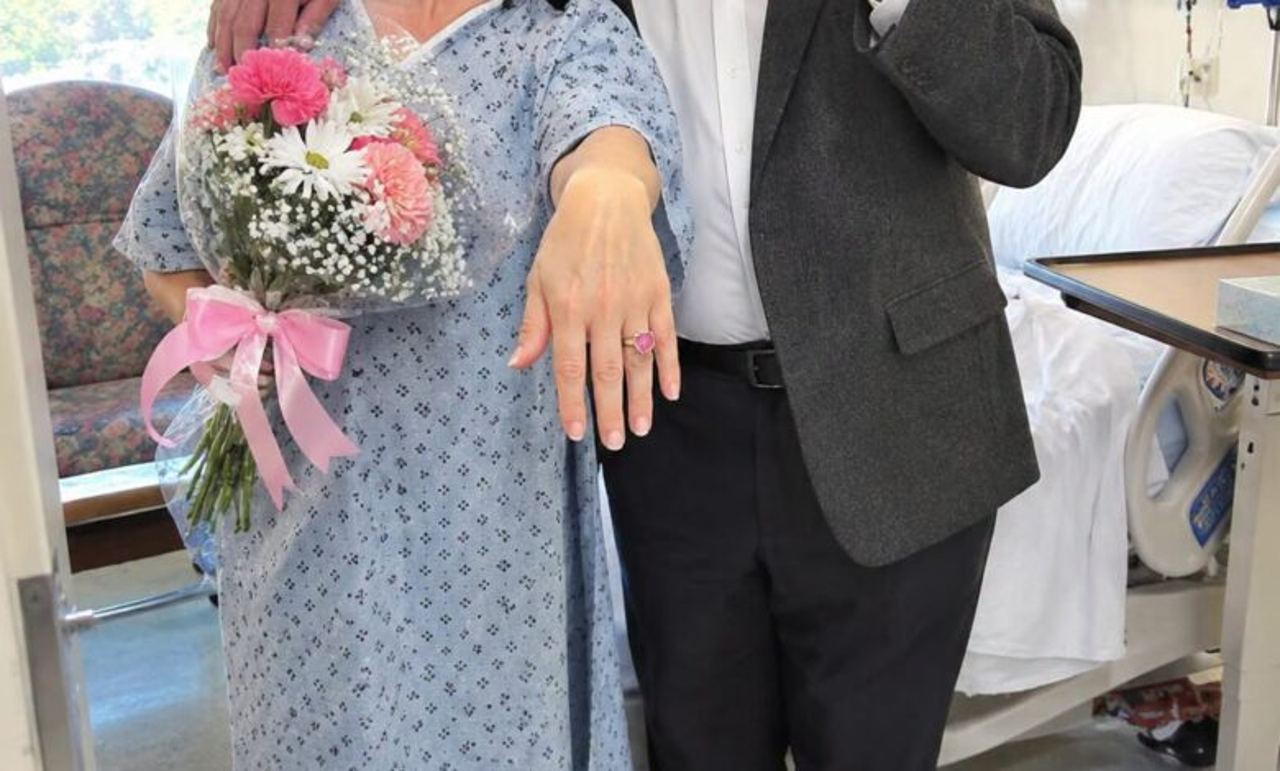
It took some arranging. In Missouri, you need a marriage license from the county Recorder of Deeds, and ordinarily both people must appear in person. Margaret could not leave her bed. But the Greene County Recorder’s office, as it turned out, had dealt with this before. On Friday morning, a deputy clerk named Shirley came out to St. Luke’s with the paperwork in a manila folder, sat beside Margaret’s bed, and had us both sign while Daniel stood in the corner with his arms folded. Shirley got a little teary when Margaret asked whether she would like to stay for the ceremony.
I wore the same suit I always wore to church on Sundays, because it was the only one I owned. A charcoal gray JCPenney suit, eleven years old, a little shiny at the elbows. I ironed my good white shirt twice.
The evening before, I drove out to the flea market on old Route 66 west of town and spent an hour walking up and down the aisles looking for wedding bands. I did not have much money. Pastors of ninety-person churches generally don’t. At the back, an elderly man was selling jewelry from a glass case, and he had two plain gold bands—a man’s and a woman’s—for forty dollars together.
But the woman’s band was too large for Margaret’s fingers now, so thin from illness. The only ring in her size was a little silver band with a tiny pink enamel heart on top. The sort of ring you’d buy for a twelve-year-old girl. Eight dollars.
I nearly didn’t buy it. I nearly drove to Kay Jewelers at Battlefield Mall and put something better on my credit card.
But something told me to buy that one.
The ceremony took place at two o’clock on Saturday afternoon. My associate pastor at Grace Community, a young woman named Reverend Carla Ruiz, came to officiate. Denise, the charge nurse, came too, along with two other nurses from the floor and Shirley from the Recorder’s office, who had driven back on her day off. Daniel came in a navy sport coat. He stood by the window with his hands in his pockets and said nothing.
The nurses had brought flowers from the gift shop. Pink and white carnations in a plastic vase sat on the windowsill. Someone had taped a small paper heart to the IV pole.
Margaret wore her blue scarf and a pink bed jacket Denise had somehow found for her. She had asked one of the nurses to put on a little lipstick. When I walked through the door in my JCPenney suit, her whole face lit up.
“Well, look at you, Reverend,” she said. “No ruffles.”
Carla read from First Corinthians. Love is patient, love is kind. Love keeps no record of wrongs. Margaret held my hand through all of it.
When it was time for the rings, I took out the little silver band with the pink heart and slid it onto her finger. It fit exactly.
Margaret looked down at it. She raised her hand and turned it in the afternoon light spilling through the window, and that absurd little pink heart caught the sun.
She laughed so hard the nurses had to come check her monitors.
“Tommy,” she gasped, wiping at her eyes. “Tommy Calloway. You bought me a ring from a gumball machine.”
“It was eight dollars,” I said. “From the flea market on 66.”
“It’s my favorite ring in the whole world,” Margaret said. “I’m never taking it off.” She looked at me, still laughing, tears streaming down her cheeks. “Not ever.”
Carla said, “By the power vested in me by the State of Missouri, I now pronounce you husband and wife.”
I bent and kissed my bride very gently on the lips, the same way I had kissed her under the bleachers at the homecoming game in 1979.
When I straightened, I saw Daniel at the window. He was crying. Silently. He had turned his face toward the glass so no one would notice. But I noticed.
For a few precious days, I was at last Margaret’s husband.
I brought a cot into her room. The nurses did not object. Every night I slept beside her bed. In the mornings, I read to her from the Psalms and from a paperback Agatha Christie mystery she had started in Tulsa and wanted to finish. She fell asleep in the middle of most chapters. When she woke, she would ask, “Did Poirot catch him yet?” and I would say, “Not yet,” and she would reply, “Good. Don’t let him catch him while I’m asleep.”
As the days passed, she spoke less. She slept more. But when she was awake, she held my hand. And sometimes she would look at me for a long time without speaking, as though trying to make up her mind about something.
On the third day, she asked Daniel to get a shoebox from the trunk of her car. He returned with it—a battered old Florsheim shoebox held together with rubber bands. She asked him to place it on the windowsill. She did not open it.
On the fourth day, she woke at three in the morning. I was awake too, lying on my cot, watching the monitor lights.
“Tommy,” she whispered.
“I’m here.”
“Do you remember what you said? On the steps? Prom night?”
“I said I’d marry you.”
“No.” She shook her head faintly on the pillow. “After that. When I asked why you wanted to become a minister.”
I thought about it. I couldn’t remember.
“You said,” Margaret whispered, “because you wanted to spend your life telling people the truth. Even the hard truths. Because the truth is the only thing that ever really sets anybody free.” She was quiet for a long time. “I’ve thought about that every day for forty-five years.”
“Margaret,” I said. “What’s wrong?”
She did not answer. She only squeezed my hand and closed her eyes. A minute later, she was asleep again.
Five days after our wedding, on a Thursday evening in late March, with the window cracked open and the spring peepers singing in the creek behind the hospital, Margaret Ellison Pierce Calloway died. I was holding one of her hands. Daniel was holding the other. She was still wearing the little silver ring with the pink heart.
Losing her broke my heart. I had spent forty-five years missing her without realizing how much I missed her, and then I had her for nineteen days.
But I was still grateful. I have buried many people. I have learned that grief is simply love with nowhere left to go. And I was grateful that fate had brought us back together, even if only for nineteen days.
We buried her on Monday at Greenlawn Cemetery in Springfield, beneath a large oak tree. She had asked to be buried in Springfield, not in Tulsa beside Walter. Daniel told me that at the funeral home. I did not understand why then.
The funeral was held at Grace Community, my church, at eleven o’clock on a gray morning. Carla Ruiz officiated, because I could not. Around forty people came. Some were from Central High, people I had not seen in forty-five years, who had read the obituary in the Springfield News-Leader. A few were Margaret’s friends from Tulsa, who had driven up that morning. Daniel’s wife, Jenna, came with Lily and Sam, who sat in the front pew in their Sunday clothes, swinging their legs.
Afterward, I stood outside on the church steps in the cold, shaking hands the way I have after a thousand funerals. When the last car pulled out of the parking lot, I was alone there on the steps.
Then Daniel came out of the church.
He walked slowly down the steps toward me. He looked uneasy. His face was pale, and he kept wetting his lips. He was gripping a sealed envelope in both hands so tightly that the paper had bent.
“Tom,” he said. “There’s something you need to know.”
He held out the envelope. It was a plain white business envelope, thick with a few sheets inside. Across the front, in Margaret’s handwriting, were the words: Tommy. Only after.
“You don’t know the whole truth about Mom,” Daniel said. His voice sounded rough. “She left this for you. She made me promise I wouldn’t give it to you until after she was gone. Not one minute sooner.”
I took the envelope. I studied Daniel’s face. He looked like a man waiting for a sentence to be pronounced.
“Do you know what it says?” I asked.
He didn’t answer aloud. He just nodded once. Then he looked away, out across the parking lot at the gray sky.
I opened the envelope on the steps of my own church. Inside were three folded sheets of hospital notepaper, covered in Margaret’s handwriting. Small and slanted and shaky, but unmistakably hers.
I unfolded the sheets carefully and began to read.
The very first sentence nearly made my knees give way.
Tommy, you didn’t find me by accident. I found you.
I sat down on the church steps. I could no longer stand. Daniel sat beside me, a little distance away, and said nothing while I read.
Tommy, you didn’t find me by accident. I found you.
When they told me in January that the cancer was everywhere, I went home and sat in Walter’s recliner for two days. Then I looked you up on the computer. Daniel helped me. For years, I had known you were a minister in Springfield. I had looked you up before. A dozen times. Every time, I closed the computer. I was too frightened.
This time, I made some calls. I found out which hospital you visit. I asked my oncologist in Tulsa to transfer me to St. Luke’s. I told him it was for a clinical trial. It wasn’t. It was for you.
I asked the nurse for a Methodist chaplain. I knew exactly who she would send.
I’m sorry for the deception. But I couldn’t call you. I didn’t know how. Forty-five years is too long to say this over the telephone.
So I’m saying it here, where I don’t have to watch your face while you read it. Because I’m a coward, Tommy. I’ve been a coward since I was eighteen years old.
When you left for Wheaton in August of 1981, I didn’t know I was pregnant. I found out at the end of September.
I stopped reading. I lifted my eyes from the page. Daniel was sitting beside me on the church steps, elbows on his knees, his face buried in his hands.
I looked back down.
I wrote you a letter. Six pages long. I told you everything. I told you I was scared and that I loved you and that I didn’t know what to do. I gave it to my father to mail because I didn’t have a stamp. That is the truth. I didn’t have a stamp.
He read it. Then he burned it in the fireplace right in front of me.
He said a deacon’s daughter was not going to marry a delivery driver’s son who would still be in school for another seven years. He said I would ruin both your life and mine. He said you would have to leave Wheaton and drive a truck like your father. He said if I contacted you, he would go to your scholarship committee and tell them what you had done.
I was eighteen, Tommy. I believed him.
Walter Pierce was a mechanic who had fixed my father’s Cadillac. He was ten years older than I was and attended our church, and he had been sweet on me for a year. My father went to him. I don’t know precisely what he said. I only know that two weeks later, Walter came to our house and sat with me on the porch swing—the same one you used to sit on—and asked me if I was in trouble. I told him the truth. All of it.
He said he would marry me anyway. He said he would raise the baby as his own and never tell another soul. He said, Maggie, you don’t have to love me. Just let me take care of you.
So I called you. I told you I was marrying Walter. I hung up before you could hear me crying.
Daniel was born on the eleventh of June, 1982, in Tulsa.
He’s yours, Tommy. He’s your son.
The paper shook in my hands. I could no longer make out the words. I lowered the letter to my knee and pressed a hand over my eyes.
Beside me, Daniel did not move.
After a while, I lifted the letter again.
Walter knew. He always knew. He loved Daniel as if he were his own blood. He taught him how to fish and how to fix a carburetor and how to tell the truth, and he was the best father I have ever seen. But six years ago, when he was dying, he made me promise him something. He said, Maggie, that boy has a right to know who his father is. And that man has a right to know he has a son. He said, I raised him, but I didn’t make him. Don’t let me carry that to my grave.
I told Daniel after Walter’s funeral. He was thirty-eight. He didn’t speak to me for four months.
And I still didn’t tell you. For six more years, I didn’t tell you. I kept meaning to. I kept being afraid. Afraid you would hate me. Afraid you would think I had stolen your son from you. Afraid you would be right.
Then the cancer came. And I knew I had run out of time.
Tommy, I asked you to marry me because I wanted Daniel to see it. Just once. His mother and his father standing together. I wanted him to see the man I have loved my whole life, in his only suit, placing a ring on my finger. I wanted to give him that, even if I couldn’t give him everything else. It was selfish. I know it was. But not once in my life had I ever asked for anything just for myself. I asked for this.
And I wanted to be your wife. Even if only for a week. I wanted to know what it would have been like.
It was everything, Tommy. It was everything I imagined there on the steps of the Shrine Mosque.
The truth is the …